All About Rubies: An expert Guide to Ruby Jewellery
For millennia, rubies have ignited the human imagination. With their rich, blood-red glow and deep symbolic meaning, these exquisite gemstones are far more than just beautiful; they’re steeped in history, legend, and natural wonder. From royal crowns to contemporary jewellery, rubies have always commanded admiration. In many cultures, especially across the Far East, they’ve earned the reverent nickname: The King of Gems.

Ruby and Diamond Double Halo Ring in Platinum £5,995.00
What Is A Ruby?
Rubies are a variety of the mineral corundum (aluminium oxide), with their iconic red colour resulting from traces of chromium. While all other colours of corundum are classified as sapphires, only the red variety can be called a ruby—a distinction that adds to its prestige. Before gemmological knowledge and testing equipment existed, spinels and garnets were often misidentified as rubies, the famous being the Black Prince's ruby, a large red spinel, not a ruby, set in the Maltese cross in the front of the imperial state crown of England.

Ruby and Diamond Daisy Cluster Pendant £1,495.00
Ruby Colours
The most coveted rubies are not merely red—they exhibit a vivid, intense hue often described as “pigeon blood red.” This particular tone is rare and commands a premium price. However, rubies come in a range of colours, from bright red and purplish-red to deep pinkish-red and darker, garnet-like shades.
There is an ongoing debate in the gem industry about where a pink sapphire ends and a ruby begins. It’s a subjective distinction, but deep saturation and the iconic pigeon blood tone are key indicators that you’re looking at a true ruby of premium quality.

Ruby & Diamond Halo Ring in Platinum £3,725.00
What Do Rubies Symbolise?
Ruby is the birthstone for July and has long symbolised passion, power, and protection. In ancient India, rubies were believed to offer peace and shield warriors in battle. Medieval Europeans wore them for health, wealth, and wisdom—and to ward off evil thoughts.
Thanks to their fiery hue, rubies are also linked with love, vitality, and emotional intensity, making them popular choices for romantic gifts and ceremonial jewellery. They’re traditionally gifted for the 40th wedding anniversaries, signifying lasting commitment and passion.

Ruby & Diamond Line Bracelet £6,750.00

Where Are Rubies Found?
As with diamonds, ethical sourcing has become an important part of the ruby trade. Some regions, like Sri Lanka and Australia, utilise gentler mining methods such as riverbed collection, which minimises environmental damage. Efforts are also underway to restore topsoil and adopt regenerative practices.
Rubies typically form in metamorphic rocks, pegmatites, and alluvial deposits. They’re often found as water-worn tabular crystals and pebbles in gravel beds, discovered through careful hand-sorting rather than industrial-scale mining.
Key Ruby Sources and Their Characteristics
Myanmar (Burma) – Especially the Mogok region, famed for world-class pigeon blood rubies.
Thailand – Produces darker, more garnet-like stones.
Sri Lanka – Known for lighter, pinkish rubies that often contain rutile needles, pyrite inclusions, and colour zoning.
Mozambique – An emerging player producing vibrant, high-clarity stones.
Vietnam – Offers beautiful rubies with strong colour and clarity, though they often require heat treatment to remove bluish undertones.
Each origin gives rise to rubies with unique traits, from subtle inclusions to colour saturation and transparency, allowing us to enjoy all their natural characteristics and appreciate their variety.

Shared Claw Ruby & Diamond Ring in Yellow Gold £2,675.00
Ruby Jewellery
Rubies are more than just birthstones; they are cultural icons. Traditionally given for the 40th anniversaries, they appear in all forms of jewellery: rings, necklaces, earrings, and brooches. Their association with love and nobility makes them ideal for both heirlooms and statement pieces.
One of the most legendary ruby artefacts is the Liberty Bell Ruby carved in 1976, the largest mined ruby in the world. Shaped into a bell and set with diamonds, it was stolen in 2011 and has never been recovered—only adding to its mystique in gemstone history.

Ruby and Diamond Multi-Band Ring in Yellow Gold £2,925.00
Cleaning and Caring for Ruby Jewellery
Ranking 9 on the Mohs scale, rubies are second only to diamonds in hardness, making them excellent for everyday wear. Still, a few care tips will ensure their longevity:
Clean with warm, soapy water and a soft brush.
Avoid harsh chemicals, extreme heat sources and ultrasonic cleaners, especially for treated stones.
Store separately to prevent scratches from or to other gems.
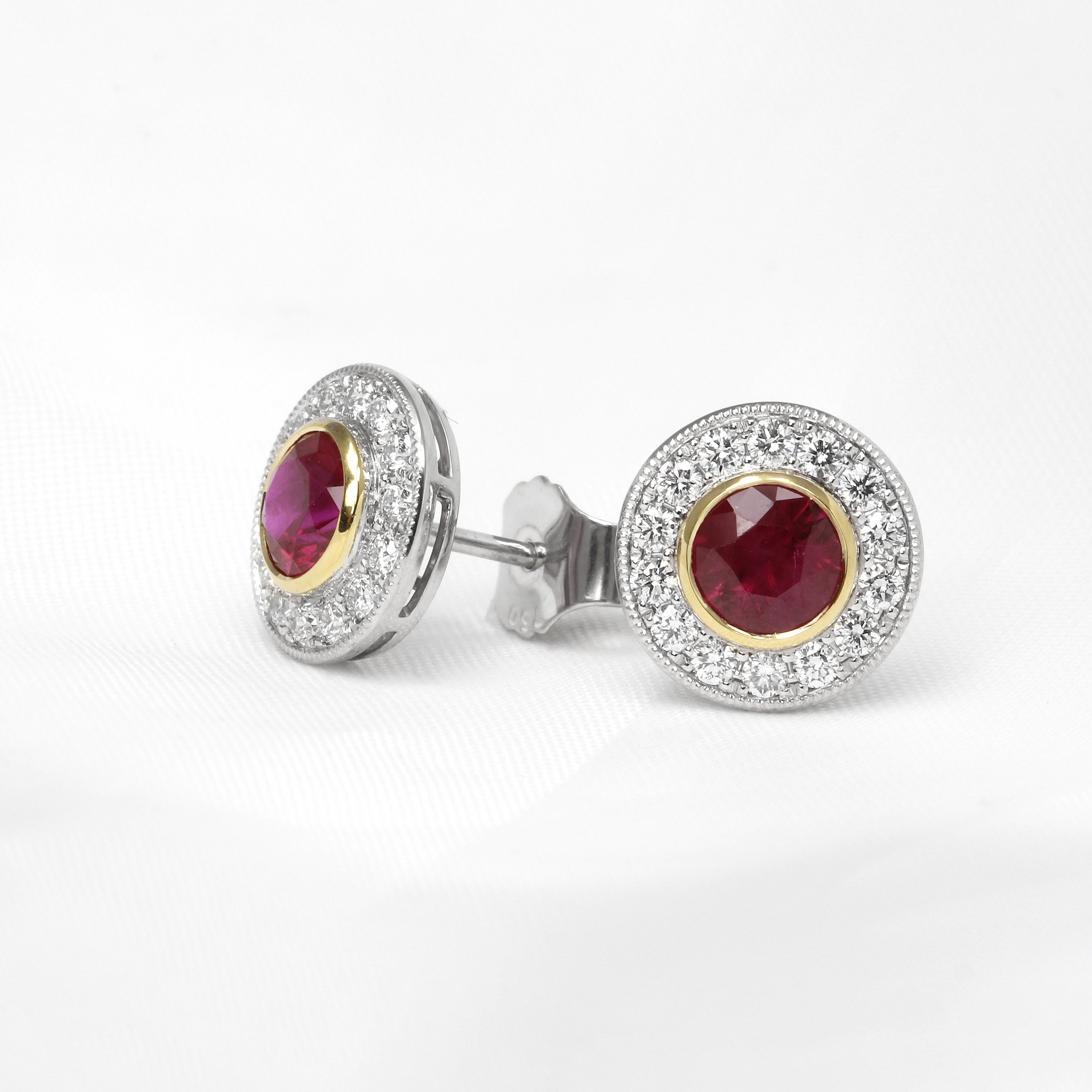
Ruby and Diamond Halo Stud Earrings in White and Yellow Gold £3,195.00
Ruby Treatments
Most rubies undergo heat treatment to improve colour and clarity. This process can:
Remove brown or blue undertones, especially in rubies from Thailand, Vietnam, and Mong Hsu.
Reduce the appearance of silk—light-reflecting rutile or boehmite inclusions that cause haziness.
While heat treatment is widely accepted, some rubies are also fracture-filled with glass, resins, or oils to enhance clarity. These enhancements can make lower-quality stones appear more vibrant, but they are less stable and not generally preferred by connoisseurs. At Timothy Roe Fine Jewellery, we favour rubies that are heat-treated only, without fracture filling.

Ruby & Diamond Drop Necklace £2,275.00
Find Your Perfect Ruby Jewellery Piece
At Timothy Roe Fine Jewellery, we create exquisite one-of-a-kind ruby jewellery, including ruby rings, pendants, earrings, and more. Looking for something personal? Our bespoke jewellery service brings your dream ruby piece to life. Explore our ruby collection or book a consultation with our master craftsmen today.
FAQs and Helpful Information
How strong are rubies?
Strength refers to durability. Hardness and durability mean slightly different things. Rubies score 9 out of 10 on the Mohs hardness scale, making them one of the hardest gemstones after diamonds so resist scratching well. They lack natural clevavage planes so this makes them stronger and in some cases better than diamonds because they do not cleave. Diamonds have natural cleavage planes. This excellent durability makes them suitable for daily wear in rings and other jewellery.
What colours do rubies come in?
While rubies are best known for their rich red hue, they can range from pinkish-red to deep blood red. The finest rubies display a vibrant, slightly bluish-red colour often referred to as “pigeon’s blood.”
What month is the ruby the birthstone for?
Ruby is the birthstone for July. It symbolises passion, protection, and prosperity, making it a meaningful gift for those celebrating a July birthday or marking a significant life event.
How expensive are rubies?
Rubies can be very expensive, especially those with vivid colour, high clarity, and minimal treatment. Fine rubies are rarer than diamonds, with top-quality stones fetching significant prices per carat.
How can you tell if a ruby is real?
Real rubies usually have natural inclusions, can show pleochroism and have a deep, vibrant red colour. They are hard enough to resist scratching but over time may show abrasion. There are many synthetics on the market and man made glass (paste) is common therefore, professional testing is recommended to confirm authenticity.
Are rubies good for everyday wear?
Yes, rubies are ideal for everyday wear due to their hardness and durability. Whether set in rings, earrings, or pendants, rubies can withstand regular use with proper care and maintenance.